
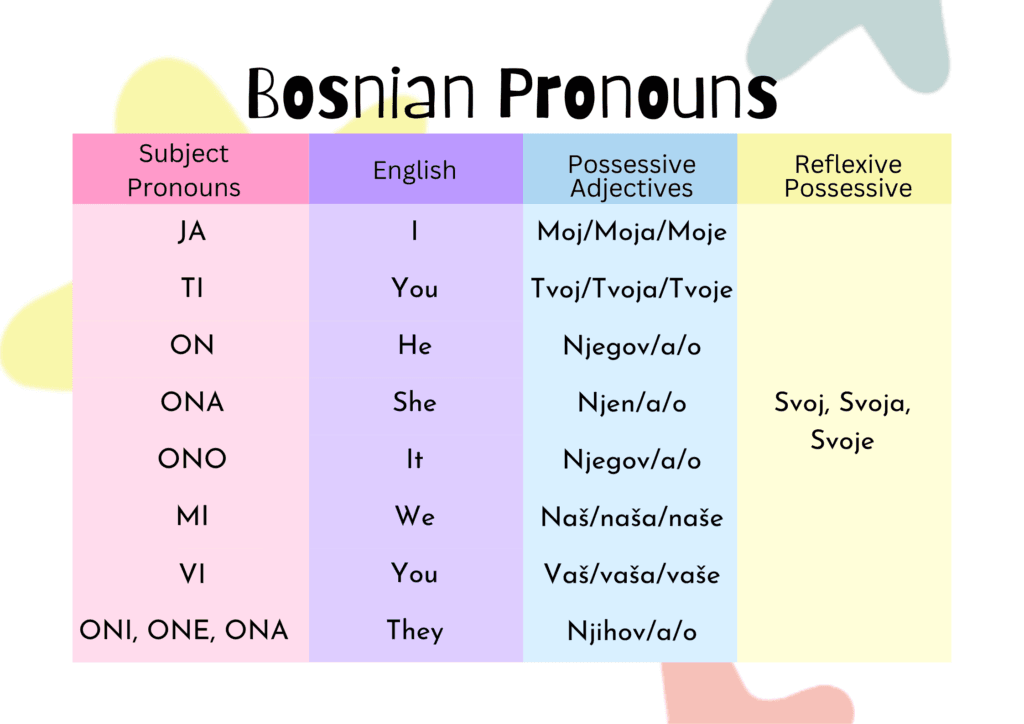
Struggling with Bosnian pronouns? Learn how to use “svoj” in Bosnian correctly. Understand why it’s different from other possessive pronouns, like moj, tvoj, and njegov. Examples, exercises, and common mistakes explained.
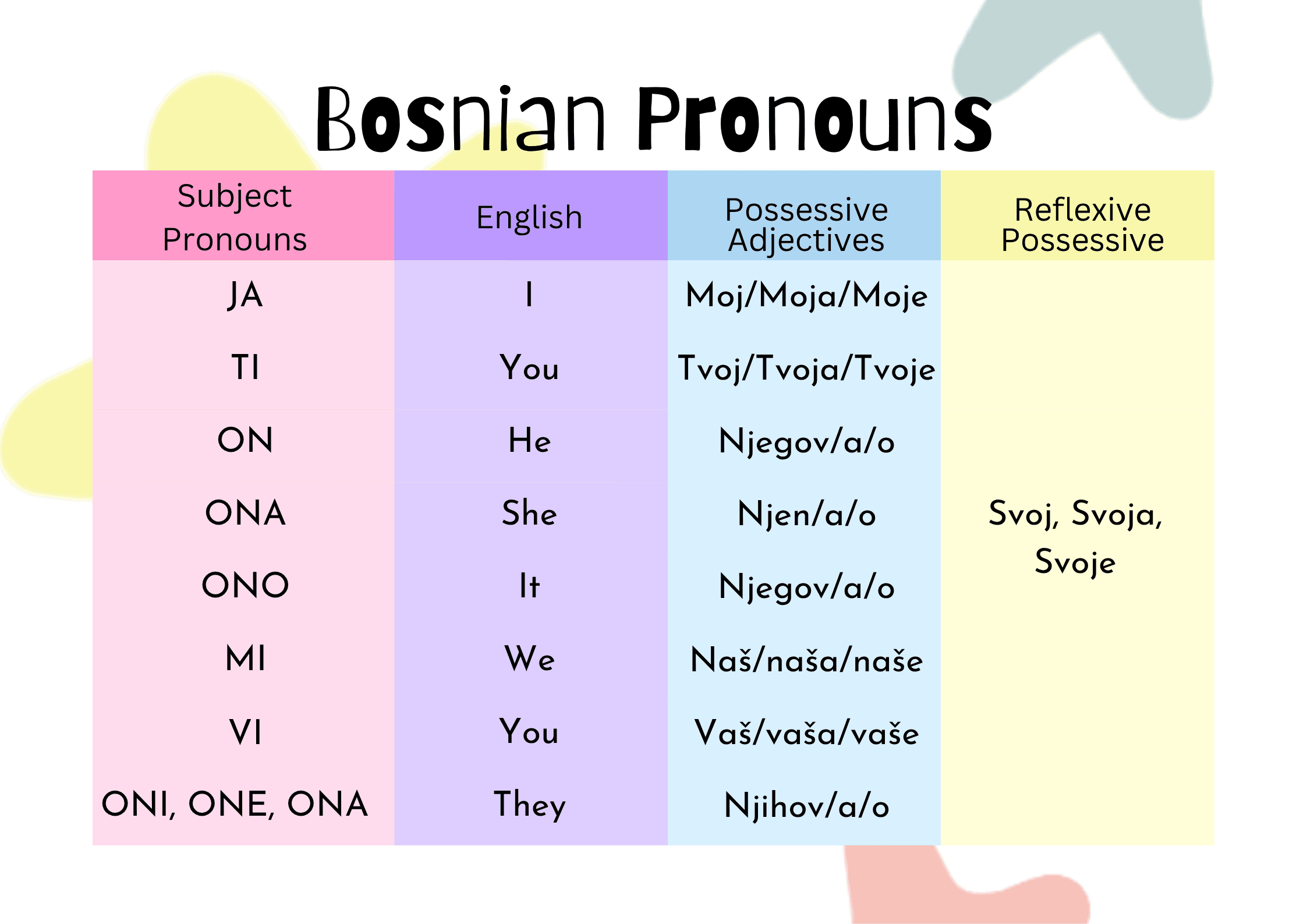
If you’re learning Bosnian, you’ve probably seen the word “svoj” and wondered: Isn’t that just “my”? Why can’t I just use moj?
You’re not alone. “Svoj” is one of the trickiest concepts for English speakers because it doesn’t exist in English. But with the help of this article you will see that the concept is really simple, and once you understand it, your Bosnian will sound much more natural. My students often figure this out quite quickly, once they receive a detailed explanation.
In this guide, I’ll explain:
- What “svoj” actually means
- How it’s different from the possessive pronouns moj, tvoj, njegov, njen, naš, vaš, njihov
- When to use it (and when not to)
- Common mistakes to avoid
Want to learn Bosnian with an experienced teacher? Check out my lesson offers here.
Table of Contents
The pronoun svoj in Bosnian means “one’s own.” It refers back to the subject of the sentence, meaning the person doing the action.
So when the subject of the sentence is the owner as well, you will use “svoj” instead of the other possessive pronouns.
Let’s see what that looks like in a sentence:
| I’m reading my book. | Čitam svoju knjigu. |
Here’s the subject is I (ja). The subject also owns the book. That’s why we use “svoju” instead of “moju”.
Here’s when the correct use really matters. Let me show you some examples with 3rd person subjects:
| She loves her mother. | Ona voli svoju majku. |
| They forgot their keys. | Zaboravili su svoje ključeve. |
In the first example, if I used “njenu” instead of “svoju”, this would mean that the owner is different from the subject. So there would be one woman we are talking about (she), but another woman whose mother she loves. So it’s not her own mom that she loves, it’s another woman’s mom. By using “svoju”, we’ve clarified that it actually is the subject’s mother, and not someone else’s.
Subject vs. Owner
The difference between “svoj” and other possessive pronouns (moj, tvoj, njegov, etc.) is simple: If the owner is the same as the subject, use “svoj”. If they are different, use the regular possessive pronoun.
| Čitam svoju knjigu. | I’m reading my own book. (I am the one reading, and the book belongs to me) |
| Čitam moju knjigu. | I’m reading my book. (Same meaning, but less natural. Svoj is preferred.) |
| Čitaš svoju knjigu. | You’re reading your own book. (You are reading, and the book is yours) |
| Čitaš tvoju knjigu. | You’re reading your book. (Grammatically correct, but svoj sounds more natural) |
In the first and 2nd person, “svoj” and “moj” or “tvoj” often mean the same thing, but “svoj” is more natural in Bosnian.
The real difference becomes clear in the third person (he/she/they):
| Ona voli svoju kuću. (She loves her own house) | Ona voli njenu kuću. | Without svoj, it sounds like she loves another woman’s house |
| Marko je zaboravio svoj telefon. (Marko forgot his own phone) | Marko je zaboravio njegov telefon. | Without svoj, it sounds like Marko forgot another man’s phone |
When NOT to Use Svoj in Bosnian
There are two important situations where you cannot use “svoj“:
1. When the subject is not the owner
If the person doing the action does not own the thing, use the regular possessive pronoun.
| On koristi njen kompjuter. (He uses her computer) | He is the subject, but the computer belongs to her (different person): cannot use svoj |
| On koristi svoj kompjuter. (He uses his own computer) | He is the subject, and the computer is his own: svoj is correct |
2. In the subject itself
Svoj cannot be the subject of a sentence. It only describes an object that belongs to the subject.
| Moja knjiga je na stolu. (My book is on the table) | Svoja knjiga je na stolu. (incorrect) |
Like other adjectives, svoj changes based on gender, number, and case. Here’s the nominative form:
| Gender | Singular | Plural |
|---|---|---|
| Masculine | svoj | svoji |
| Feminine | svoja | svoje |
| Neuter | svoje | svoja |
Quick Practice: Fill in the Blank
Choose between svoj and the correct possessive pronoun:
- Sumeja voli _____ (her own) majku.
- Amar je zaboravio _____ (his own) ključeve.
- Čitam _____ (my) knjigu.
- Oni su prodali _____ (their) kuću.
- On koristi _____ (her) kompjuter.
Answers:
- svoju (Sumeja is the subject, and it’s her own mother)
- svoje (Amar is the subject, and it’s his own keys)
- svoju (I am the subject, and it’s my book — svoj is natural here)
- svoju (They are the subject, and it’s their own house)
- njen (He is the subject, but the computer belongs to her — different person)
Beyond Grammar: The Cultural Meaning of “Svoj”
Understanding the possessive pronoun “svoj” opens the door to one of the most beloved Bosnian phrases: “svoj na svome.” Literally translated, it means “one’s own on one’s own”, but its real meaning goes much deeper.
Svoj na svome describes that feeling of being completely at ease, comfortable, and truly yourself when you’re in your own space. It’s the warmth of sitting in your favorite chair at home, the peace of being surrounded by your things, the quiet confidence of being exactly where you belong. When you are feeling yourself, and as if you’re at your own home. This phrase captures something that English can’t express in just a few words, and it’s a perfect example of why learning these small pronouns unlocks not just grammar, but the Bosnian way of seeing the world.
Have you ever felt “svoj na svome”? Share your experience in the comments.
If you’d like to practice using “svoj” in conversation, I offer individual lessons where we can work through examples together. You can also try writing a few sentences in the comments below, and I’ll give you feedback!
Ready to master Bosnian pronouns? [Book your free 30-minute trial →]
Wow
Amazing