
Struggling with Bosnian words for “this” and “that”? Learn the simple distance rule for ovaj, taj, and onaj with examples.
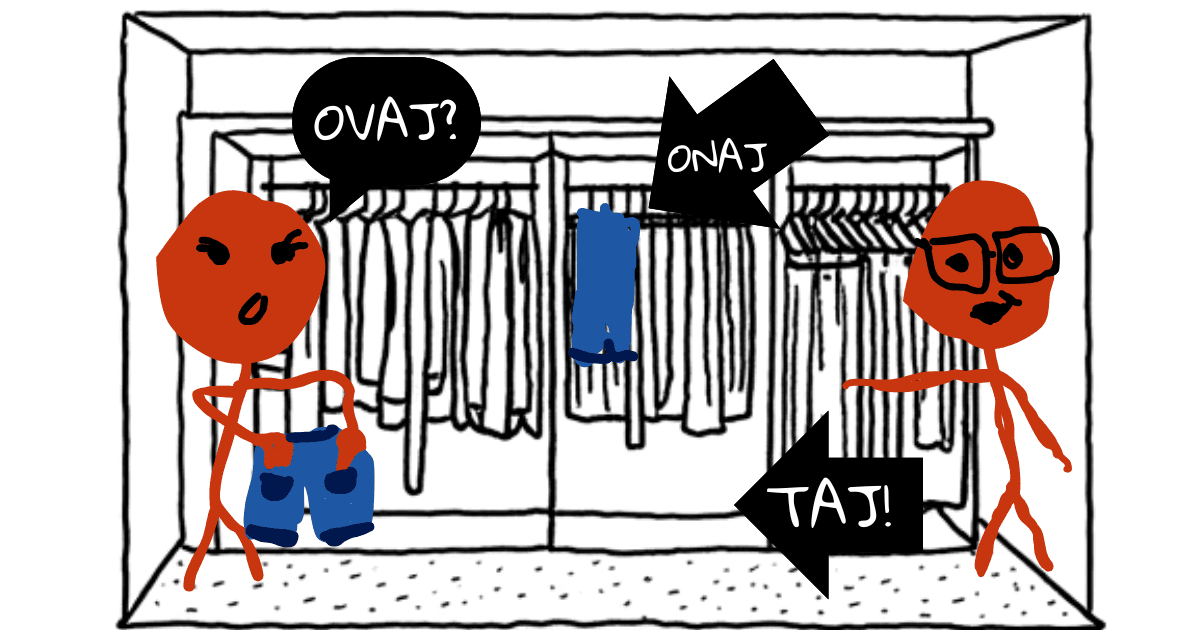
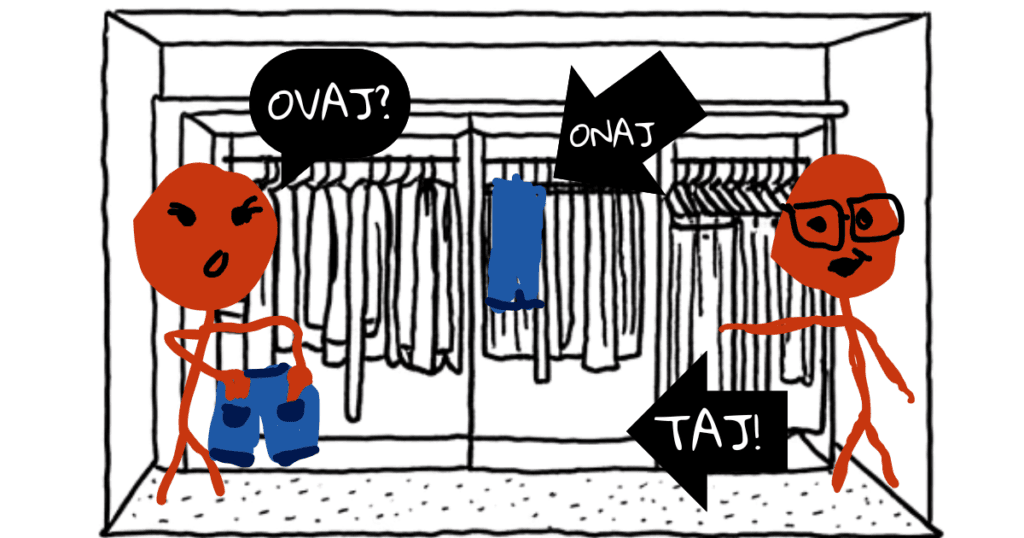
My students often get stuck on “taj” vs “onaj”. They want to use “taj” for everything that isn’t right next to them. English is simple: you have “this” for things close to you, and “that” for things farther away. Bosnian has three words for pointing at things: ovaj, taj and onaj. In this text, I will explain the Bosnian demonstrative pronouns in detail. So by the end of it, you will know which one to pick.
Table of Contents
Three Zones
Think of three “zones” around you and the person you’re speaking with.
| this | ovaj | Close to ME |
| that | taj | Close to YOU (the listener) |
| that (over there) | onaj | Far from BOTH of us |
Example Scenario
Imagine you’re sitting at a table with a friend. There’s a coffee cup in front of you, a book next to your friend, and a house visible through the window. You will say:
- Ova kafa je odlična. (This coffee is great) Because the coffee is next to you, the speaker.
- Ta knjiga je zanimljiva. (That book is interesting) Because the book is near you, the listener.
- Ona kuća je stara. (That house is old) Because the house is far from both of us.
Notice that I used ova, ta, ona? Just like the adjectives we studied in the 90+ Adjectives post, these demonstrative pronouns must match the noun in gender and number.
Singular Forms
| English | Masculine | Feminine | Neuter |
|---|---|---|---|
| This (close to me) | ovaj | ova | ovo |
| That (close to you) | taj | ta | to |
| That (far away) | onaj | ona | ono |
Plural Forms
| English | Masculine | Feminine | Neuter |
|---|---|---|---|
| These (close to me) | ovi | ove | ova |
| Those (close to you) | ti | te | ta |
| Those (far away) | oni | one | ona |
Why Bosnians Use “Taj” So Much
In my experience, learners often overuse “onaj” because they think “that” = far. But Bosnians use “taj” most of the time in conversation. “Onaj” is reserved for things that are genuinely distant, physically or emotionally.
“Taj”, “ta”, and “to” demonstrative pronouns will also be used to talk about the topic of conversation, or about something we just mentioned. For example, imagine you’re having a conversation with me. You mentioned a book you’ve read recently. I will say: “Ta knjiga mi je poznata!” (That book is familiar to me.) I used “ta” because the book is the topic of our conversation already. It is not a new subject that I am introducing.
Interested in learning more about Bosnian pronouns? Find my recent post about the possessive reflexive pronoun “svoj”.
The Special Case: Ovo, To, Ono as Sentence Subjects
You’ve learned that demonstrative pronouns must match the noun in gender: ovaj pas (this dog, masculine), ova knjiga (this book, feminine), ovo dijete (this child, neuter).
But there’s an important exception.
When the demonstrative pronoun is the subject of the sentence (standing alone, without directly touching a noun) we always use the neuter form: ovo, to, or ono.
| Ova je knjiga. (incorrect) | Ovo je knjiga. ✅ | Ovo is the subject, knjiga is later in the sentence. Ovo stands alone as the subject |
| If the pronoun is | Then use | Example |
|---|---|---|
| Directly attached to a noun (adjective position) | Matching gender (ovaj, ova, ovo) | Ovaj pas je velik. (This dog is big) |
| Standing alone as the subject (pronoun position) | Neuter (ovo, to, ono) | Ovo je pas. (This is a dog) |
Ovo je moja sestra. (This is my sister.) To je dobra ideja (That is a good idea.) Ovo su moji prijatelji. (Those are my friends – we used neuter singular even for the plural “friends”.)
This is one of the most common mistakes my students make. They learn that “knjiga” is feminine, so they want to say “Ova je knjiga” or “Ta je knjiga”; but that sounds very strange to a Bosnian ear.
- 7 Bosnian Words You Need to Know That Don’t Translate Directly into English
- Koji vs Što in Bosnian: Easy Grammar Guide & Examples
- How to Form Bosnian Plurals: The 4 Rules Every Learner Needs
- Months in Bosnian & How to Tell Time: Complete Guide with Pronunciation
- 20 Bosnian Football Phrases & Chants You’ll Hear at the 2026 World Cup
Pronouns Need Cases Too
As you can see below, the Bosnian demonstrative pronouns also take cases (for example, it’s “tu, not “ta” in one of the exercises). “Cases” are special endings that depend on the context of the sentence. That’s a topic for another post. But for now, just know that what you’ve learned here is the nominative (subject) form. If you want to learn more about those and practice them in real time, check out my lesson offers here.
Bosnian Demonstrative Pronouns Practice
Fill in the blank with the correct form of ovaj, taj, or onaj.
- ______ (This, close to me) kafa je hladna.
- Dodaj mi ______ (that, near you) olovku.
- Vidi ______ (that over there, far from both) planinu!
- ______ (This, close to me) knjiga je odlična.
- ______ (That, near you) tvoja ideja nije loša.
- ______ (That over there) avion leti visoko.
Answers:
- Ova kafa je hladna.
- Dodaj mi tu olovku.
- Vidi onu planinu!
- Ova knjiga je odlična.
- Ta tvoja ideja nije loša.
- Onaj avion leti visoko.
Summary Cheat Sheet
| Situation | Use | Example |
|---|---|---|
| Close to ME (speaker) | ovaj / ova / ovo | Ova kafa |
| Close to YOU (listener) | taj / ta / to | Ta knjiga |
| Far from BOTH | onaj / ona / ono | Ona kuća |
| Referring to something just mentioned | taj / ta / to | Ta knjiga mi je poznata |
| Standing alone as subject (“This is…”) | ovo / to / ono | Ovo je knjiga |
Ready to master Bosnian demonstrative pronouns? [Book your free 30-minute trial →]